

Baby Food Guide
Looking for healthy Indian foods to help your baby gain weight naturally? The best approach is not sugary snacks or bigger portions. It is consistent, age-appropriate, nutrient-rich meals that support steady growth alongside breast milk or formula.
Important parent note: Baby weight is best understood through your child's growth curve, feeding pattern, energy, wet diapers, and milestones. This guide is educational and not medical advice. If your baby is losing weight, not gaining over time, refusing feeds, vomiting frequently, or missing milestones, please speak with your pediatrician.
What healthy weight gain really means
Healthy weight gain is about much more than the number on the scale. During the first year, babies are building brain connections, bones, muscles, immunity, and feeding skills. Those systems need protein, healthy fats, iron, calcium, complex carbohydrates, and vitamins.
Your baby is generally on a reassuring path when they keep following their growth curve, stay active and alert, feed well, have regular wet diapers, and continue meeting developmental milestones. Some babies are naturally smaller because of genetics, appetite, or growth pattern, so comparison with another child can be misleading.
Nutrients that support baby growth
- Healthy fats: ghee, avocado, full-fat yogurt, eggs, and safely introduced nut powders can make meals more energy-dense.
- Protein: moong dal, lentils, paneer, yogurt, and eggs help support muscle and tissue growth.
- Complex carbohydrates: ragi, rice, oats, millets, sweet potato, and raw nendran banana give steady energy.
- Iron: iron-rich foods become especially important from around 6 months. Ragi, lentils, moong dal, eggs, and greens can help. Pairing them with vitamin C-rich foods may improve absorption.
15 healthy Indian foods for baby weight gain
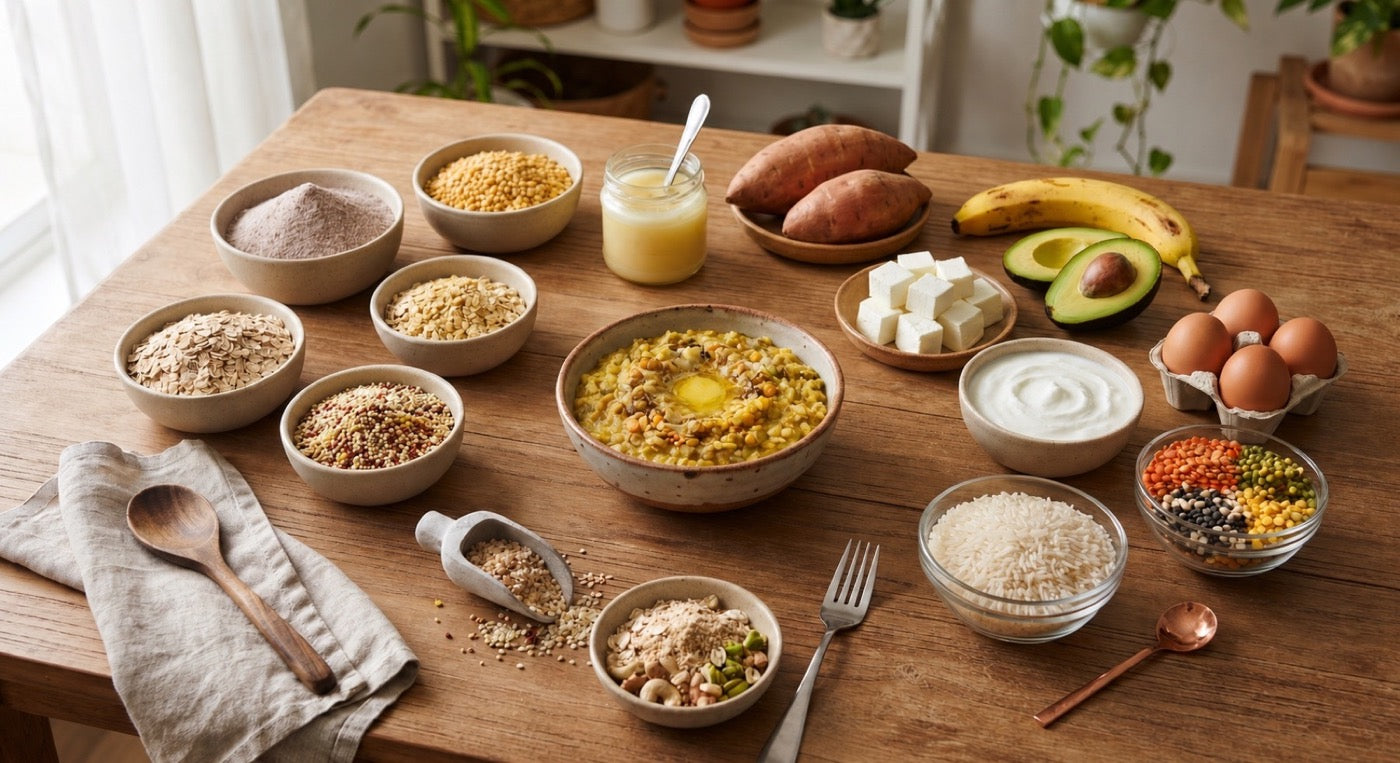
There is no one magic food. Think of this list as a rotation: a few grains, a few dals, soft fruits and vegetables, and small amounts of healthy fat.
6m+
1. Sprouted ragi
Why it helps: A traditional Indian first food with complex carbohydrates, calcium, iron, and a smooth porridge texture when cooked well.
How to serve: Start as a thin porridge. As your baby grows, use it for soft pancakes, dosa, or waffles.
Helpful option: Live Indianly Sprouted Ragi
6m+
2. Moong dal
Why it helps: Gentle plant protein with iron and folate. It works well as dal puree, soup, or soft khichdi.
How to serve: Cook until very soft and mash or blend depending on your baby's texture readiness.
Helpful option: Live Indianly Brown Rice & Moong Dal
After solids are established
3. Ghee
Why it helps: Adds healthy fat and energy density to meals without relying on sugar.
How to serve: Stir a small amount into cooked dal, khichdi, rice, or porridge after cooking.
6m+
4. Sweet potato
Why it helps: Naturally sweet, soft, and rich in complex carbohydrates and vitamin A.
How to serve: Steam and mash, or mix with dal, ragi, or a tiny amount of ghee.
Helpful option: Live Indianly Sweet Potato Sprouted Ragi Mix
6m+
5. Raw Nendran banana
Why it helps: A familiar South Indian baby food that provides slow-release carbohydrates and a filling porridge base.
How to serve: Cook as a warm porridge and serve smooth. Rotate with ragi, rice, and oats for variety.
Helpful option: Live Indianly Raw Nendran Banana
6m+
6. Avocado
Why it helps: A soft food rich in healthy monounsaturated fats, fiber, folate, and vitamin E.
How to serve: Mash plain or combine with banana once both foods have been introduced safely.
8m+ or when texture-ready
7. Paneer
Why it helps: Provides protein, calcium, and fat in a familiar Indian format.
How to serve: Use soft homemade paneer, mashed well, or mix tiny crumbles into khichdi.
Around 6m+ as a food
8. Plain full-fat yogurt
Why it helps: Gives protein, calcium, fat, and probiotics. Choose unsweetened plain yogurt.
How to serve: Serve plain or with mashed fruit. Avoid sweetened flavored yogurt.
Around 6m+ if introduced safely
9. Eggs
Why it helps: A complete protein with healthy fats and choline for growth and brain development.
How to serve: Serve fully cooked, soft scrambled or mashed boiled egg. Watch for reactions and discuss allergy concerns with your pediatrician.
6m+
10. Lentils
Why it helps: Dal varieties such as moong, masoor, toor, and urad bring protein, iron, and flavor variety.
How to serve: Cook until soft and rotate lentils across the week instead of serving the same dal daily.
6m+
11. Rice
Why it helps: A gentle grain that pairs well with dal, vegetables, and healthy fats.
How to serve: Use as rice kanji, soft rice, dal rice, or khichdi, depending on age and texture readiness.
Helpful option: Live Indianly Brown Rice & Moong Dal
8m+ for many babies
12. Millets
Why it helps: Foxtail, little millet, kodo, barnyard, bajra, and jowar add mineral-rich grain variety.
How to serve: Introduce gradually, cook very soft, and rotate with rice, ragi, and oats.
Helpful option: Live Indianly Oats Makhana Millet Mix
7m+
13. Khichdi
Why it helps: A balanced Indian baby meal with grain, dal, vegetables, and healthy fat in one bowl.
How to serve: Cook until soft and add carrot, pumpkin, sweet potato, spinach, or ghee as appropriate.
Helpful option: Live Indianly Brown Rice & Moong Dal
After nuts are introduced safely
14. Dry fruit powder
Why it helps: Finely ground nut powders can add healthy fats and minerals, but nuts are allergens and choking hazards.
How to serve: Use only finely ground powder, never whole nuts. Introduce individual nuts safely first and follow your pediatrician's advice.
6m+
15. Oats
Why it helps: A creamy breakfast base with carbohydrates, fiber, and minerals.
How to serve: Cook as porridge and pair with banana, apple puree, yogurt, or other introduced foods.
Helpful option: Live Indianly Oats Makhana Millet Mix
Age-wise feeding guide
Continue breast milk or formula as your baby's main nutrition source while adding complementary foods. Move textures forward gradually: smooth, then mashed, then soft lumpy foods, then bite-sized family foods as your baby is ready.
| Age | What to focus on | Good Indian options | Texture |
|---|---|---|---|
| 6-7 months | Single foods and smooth first tastes | Ragi porridge, rice kanji, moong dal puree, sweet potato mash, banana mash | Smooth puree or thin porridge |
| 8-9 months | Thicker textures and mixed meals | Vegetable khichdi, yogurt, paneer, millet porridge, soft idli, mashed fruit | Mashed with soft lumps |
| 10-12 months | More variety and soft family foods | Soft dosa, upma, dal rice, soft chapati with dal, eggs, paneer, mixed grain porridge | Soft lumpy and small bite-sized pieces |
7-day Indian meal plan for healthy baby weight gain
This sample is best for older babies around 9-12 months who have already tried several foods. Adjust textures, portions, allergies, and meal timing to your baby's readiness.
| Day | Breakfast | Lunch | Snack | Dinner |
|---|---|---|---|---|
| Monday | Sprouted ragi porridge | Vegetable moong dal khichdi | Plain yogurt | Sweet potato mash with ghee |
| Tuesday | Oats with apple puree | Rice + toor dal + ghee | Avocado mash | Soft idli with dal |
| Wednesday | Oats makhana millet porridge | Vegetable khichdi | Papaya or banana | Soft paneer bhurji |
| Thursday | Ragi pancake | Whole wheat almond porridge | Steamed pear | Vegetable dosa |
| Friday | Brown rice moong dal porridge | Dal rice + ghee | Yogurt with fruit | Millet porridge |
| Saturday | Oat porridge with banana | Vegetable pulao, very soft | Avocado or fruit mash | Lentil soup |
| Sunday | Raw nendran banana porridge | Soft khichdi | Soft paneer cubes, if ready | Sweet potato ragi porridge |
Baby weight gain food chart
| Food | Age | Key nutrients | How often in rotation |
|---|---|---|---|
| Sprouted ragi | 6m+ | Complex carbs, calcium, iron | 2-3 times/week |
| Moong dal | 6m+ | Protein, iron, folate | 2-3 times/week |
| Sweet potato | 6m+ | Vitamin A, complex carbs | 2-3 times/week |
| Banana | 6m+ | Carbs, potassium | 3-4 times/week |
| Yogurt | Around 6m+ as food | Calcium, protein, fat | 3-4 times/week |
| Paneer | 8m+ or texture-ready | Protein, calcium, fat | 1-2 times/week |
| Eggs | Around 6m+ if introduced safely | Protein, fat, choline | 2-4 times/week |
| Millets | 8m+ for many babies | Minerals, fiber, slow-release carbs | 2-3 times/week |
| Khichdi | 7m+ | Balanced carbs, protein, vegetables | 3-4 times/week |
Simple pairing tips
- For iron absorption: pair ragi, dal, lentils, or greens with vitamin C-rich foods like tomato, sweet potato, amla, or age-appropriate citrus.
- For more energy: add a small amount of ghee, avocado, full-fat yogurt, or safely introduced nut powder to cooked meals.
- For better variety: rotate ragi, rice, millets, oats, dal, khichdi, and vegetable mashes instead of repeating one food every day.
Common mistakes parents make when trying to increase weight
- Comparing babies: growth curves matter more than comparison with friends or relatives.
- Adding sugar: biscuits, sweet drinks, and sweetened yogurt add calories without the nutrition babies need.
- Skipping healthy fats: small amounts of ghee, yogurt, avocado, or egg can make meals more nourishing.
- Offering too much milk right before meals: some babies eat fewer solids if they are full from milk.
- Serving the same food daily: variety supports broader nutrition and reduces mealtime boredom.
- Forcing the last bite: responsive feeding helps babies build a healthier relationship with food.
Foods to limit for baby weight gain
More calories does not always mean better nutrition. Limit sugary cereals, biscuits, packaged juices, candy, fried snacks, chips, processed cookies, sweetened yogurt, and foods high in added salt.
When to talk to your pediatrician
Speak with your pediatrician if your baby stops gaining weight over several weeks, loses weight, refuses most feeds, vomits repeatedly, has persistent diarrhea or constipation, seems unusually tired, or is missing milestones.
Short on time? Keep the food simple. Live Indianly makes clean Indian baby food bases with familiar ingredients so you can prepare porridges, khichdi-style bowls, pancakes, soft bites, and everyday meals quickly.
Frequently asked questions
Which Indian food helps babies gain weight?
No single food guarantees weight gain. Healthy baby weight gain usually comes from a balanced rotation of nutrient-dense foods such as sprouted ragi, moong dal, lentils, sweet potato, banana, paneer, yogurt, eggs, khichdi, and small amounts of healthy fats like ghee.
Is ragi good for baby weight gain?
Yes, ragi can be part of a healthy baby diet because it provides complex carbohydrates, calcium, iron, and fiber. Sprouted ragi may also be easier to digest for many families when cooked properly.
Can babies eat ragi every day?
Ragi is nutritious, but babies benefit from variety. Rotate ragi with rice, oats, millets, dal, khichdi, vegetables, fruits, yogurt, and other age-appropriate foods.
Does ghee help babies gain weight?
Ghee can add healthy fat and calories to meals when used in moderation. A small amount can be mixed into porridge, dal, khichdi, or rice after cooking.
When should babies start solids?
Most babies are ready for complementary foods around 6 months, while continuing breast milk or formula. Readiness signs include good head control, sitting with support, and interest in food.
Should I force-feed my baby to gain weight?
No. Forcing feeds can make mealtimes stressful. Offer nourishing foods regularly, watch hunger and fullness cues, and work with your pediatrician if intake or growth is concerning.
Helpful Live Indianly products mentioned
Related reading
- Baby Not Gaining Weight? Indian Foods That Help Naturally
- Starting Solids for Babies: Best Indian First Foods
- How to Read Baby Food Labels
- Why Sprouted Ragi Is a Great First Food for Babies
- How to Introduce Millets to Your Toddler
Sources and safety references
This article was edited for parent-friendly education and checked against current complementary feeding guidance from the CDC and WHO.
Final thought
Helping your baby gain weight naturally is not about chasing calories. It is about offering consistent, balanced, nutrient-rich meals in textures your baby can manage. Traditional Indian foods like sprouted ragi, moong dal, khichdi, lentils, millets, banana, sweet potato, yogurt, paneer, and ghee can be part of that steady, nourishing routine.


