

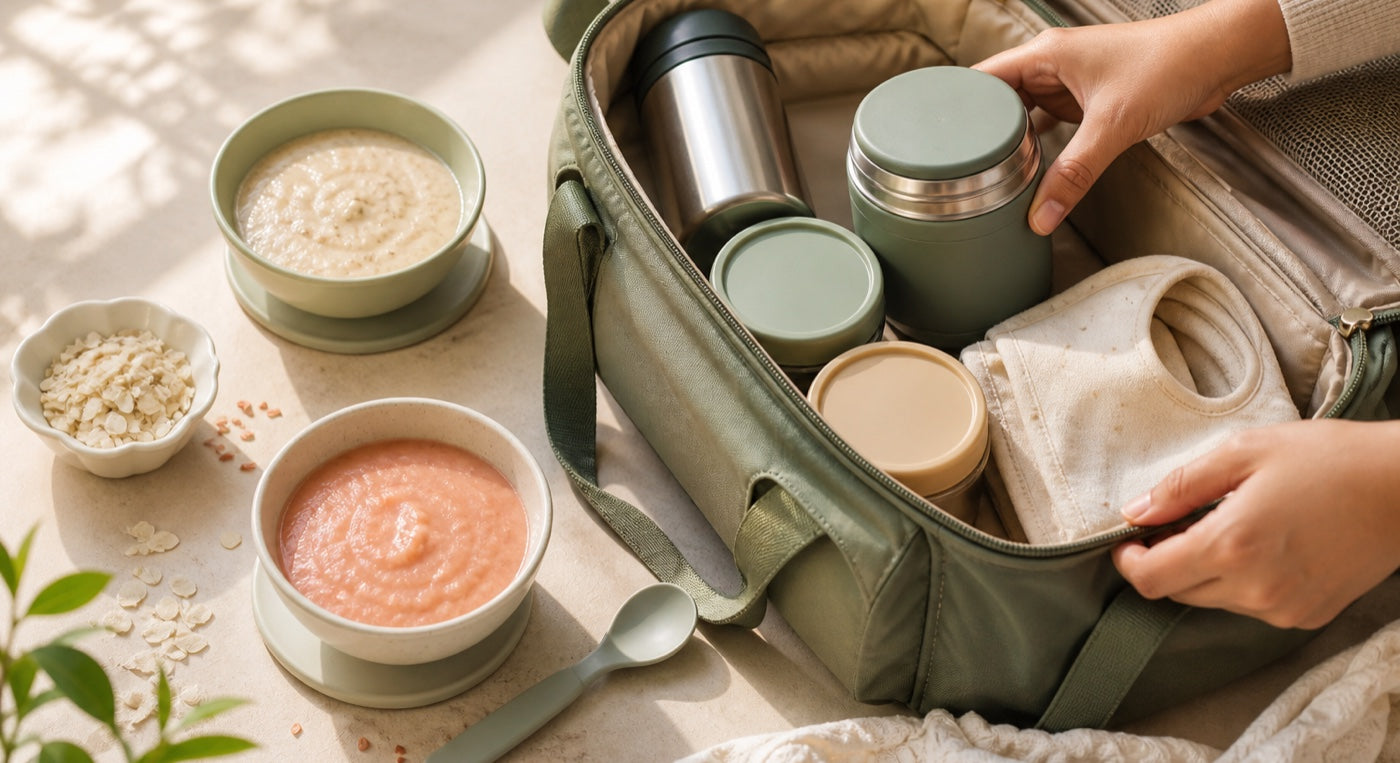
Baby travel guide
Travelling with a baby is easier when the food plan is simple: familiar foods, a texture your child already handles, safe water, correct storage and one dependable backup.
Whether you are taking a short road trip, an overnight train or a flight, the goal is not to carry your entire kitchen. A little planning can make baby food while travelling safer, calmer and much easier to serve.
Who this guide is for: Babies who have already started complementary foods and have tried the ingredients you plan to pack. The World Health Organization recommends beginning complementary foods at around 6 months, alongside continued milk feeds, and gradually adapting texture and variety to the child's abilities. If your baby has not started solids, follow your paediatrician's guidance first.
The quick travel-food rule
Before packing a meal, ask five simple questions:
- Has my baby eaten these ingredients before?
- Can I serve the usual safe texture?
- Will I have potable water?
- Can I keep it safely hot or cold?
- What is my backup if we are delayed?
A travel day is usually not the best time to introduce an unfamiliar ingredient. Pack foods your baby already eats comfortably, especially if your child has a known allergy, swallowing difficulty or medical feeding plan.
If you are just preparing for solids, start with our guide to Indian first foods for babies.
Match the texture to your baby—not only the age
Babies build feeding skills at different speeds. Use the texture your baby manages safely at home rather than changing it just because you are travelling.
| General stage | Practical travel texture | Possible familiar options |
|---|---|---|
| Around 6–8 months | Smooth, mashed or thick purée | Freshly prepared porridge, mashed banana or thoroughly mashed idli |
| Around 9–11 months | Thicker mash, soft lumps or suitable soft finger foods | Soft poha, small soft idli pieces or mashed khichdi |
| Around 12–23 months | Soft, chopped family foods | Soft vegetable upma, poha, khichdi or appropriately cut fruit |
These are broad examples, not strict milestones. Increase consistency and variety gradually as your child's abilities develop. Always seat your baby upright, keep the meal calm and supervise every bite. Do not feed a baby in a moving car or while the child is lying down, walking or crawling.
8 practical Indian travel food ideas for babies
1. A familiar dry porridge or travel mix
A dry food base is useful when you cannot safely carry a cooked meal for several hours. Keep it dry and prepare one serving only when you have potable hot water and a clean bowl and spoon.
2. Ripe banana
Carry it whole, peel it immediately before the meal and mash it to your baby's usual texture. Pre-mashed banana needs reliable cold storage.
3. Soft idli
For younger babies, mash plain idli thoroughly with a familiar safe liquid. Older babies may manage suitable soft pieces. Keep cooked idli cold with ice packs or serve it within the safe time window.
4. Soft poha or vegetable upma
Cook it soft, keep spices mild and adjust the texture before packing. Carry it only if you can keep it properly hot, properly chilled or serve it promptly.
5. Khichdi or dal-rice
A familiar rice-and-dal bowl can preserve part of the usual routine. Prepare it softer than the family version and mash or chop it as needed. A closed container alone does not make it safe for an all-day journey.
6. Curd rice—with reliable cold storage
Use pasteurised curd and keep it refrigerated throughout the journey in a cooler with frozen gel packs. If you cannot confirm it stayed cold, choose a dry or freshly prepared option instead.
7. Soft-cooked vegetables
Familiar pumpkin, carrot or sweet potato can be mashed when serving. Transport cooked vegetables properly chilled or hot, just like other cooked food.
8. A sealed backup
A factory-sealed, age-appropriate option helps when the journey is delayed. Check the ingredients, allergens, age guidance, expiry, storage and preparation directions. Never use a swollen, leaking or damaged pack.
Quick-prep travel options from Live Indianly
For little ones aged 6 months and above who have already tolerated the ingredients, these 200g mixes can be prepared one bowl at a time. Follow the pack directions: add hot water gradually, stir, cover and rest for 3–5 minutes, then cool to a safe feeding temperature.

Red Poha & Makhana
Red poha, makhana, masoor dal and cumin seeds. No added sugar or salt.
View this travel mix
Sweet Potato & Moong Dal
Sweet potato, moong dal, amaranth seeds, makhana and cardamom. No added sugar or salt.
View this travel mixKeep the main pack dry. For pre-portioned servings, use labelled airtight food-safe containers and pack a clean scoop separately. You can also explore all Travel Mixes.
Food-safety rules that matter during travel
Use safe water
Use potable water for drinking, preparing food and cleaning feeding utensils. If the local supply is uncertain, plan a reliable sealed or appropriately treated source before leaving.
Keep hands and utensils clean
Wash hands with soap and safe water before serving food and after nappy changes. Carry enough clean spoons and bowls so you do not need to reuse a soiled one.
Control time and temperature
Keep cold food at about 4–5°C or below and hot food above 60°C. Do not leave cooked or perishable food at room temperature for more than 2 hours—or more than 1 hour when it is hotter than 32°C.
Portion before feeding
Place one serving in a clean bowl. Do not return food touched by a used spoon to the main container, and discard leftovers from the serving bowl.
An insulated jar or cooler helps only if it actually maintains the safe temperature. Use enough frozen gel packs, keep the cooler closed and use a small food thermometer when relying on temperature-controlled meals. When you cannot confirm how long food has been warm, discard it.
Reduce choking risks
Prepare every food in the right shape, size and texture for your child's development. Avoid hard, small, sticky or difficult-to-chew foods. Whole nuts and seeds, popcorn, hard raw vegetables and uncut grapes are not appropriate baby travel snacks. Treat hard, whole makhana as a potential choking hazard too; for babies, use it only in a properly processed, cooked or powdered form that matches their feeding skills.
Remember the under-one rules
Do not give honey to a baby younger than 12 months. Avoid unpasteurised dairy or juice and foods with added sugar. If choosing a packaged option, our baby food label guide explains what to check.
Plan for the kind of journey
Short road journey
Feed your baby normally before leaving and carry one familiar meal or snack plus a backup. Stop the vehicle and seat the baby safely before feeding. Remember that a warm car shortens the safe holding time for perishable food.
Long road or train journey
Dry food bases, whole peelable fruit and sealed backup foods are easier to manage than several prepared meals. Carry potable water, clean bowls and enough portions for delays. If taking homemade cooked food, decide before leaving whether it will stay properly chilled or hot.
Air travel
Airport and airline rules vary, so confirm what baby food, water, ice packs and flasks are permitted. Keep dry mix in its original labelled packaging where practical. Confirm where potable hot water is available and always test the prepared food temperature before feeding.
Hotel stay
Ask whether the room has potable drinking water and reliable refrigeration or food-heating facilities. Wash utensils with safe water and keep dry ingredients away from steam and moisture. Prepare food in a clean bowl—never directly inside a room kettle.
Baby travel food packing checklist
Save this list or print the page before your trip.
Food
- Familiar meals or dry mixes
- One or two backup portions for delays
- Whole peelable fruit, if appropriate
- Original packaging and preparation directions
- Allergy information, if relevant
- Separate labelled portions
Water and temperature
- Reliable potable water
- Clean insulated flask, if needed
- Insulated food jar for properly hot food
- Cooler bag with fully frozen gel packs
- Small food thermometer for temperature-controlled meals
Feeding equipment
- Clean bowls with lids
- More than one clean spoon
- Age-appropriate cup
- Bibs and burp cloths
- Clean mat or cloth for the feeding surface
Hygiene and clean-up
- Soap or handwash
- Hand sanitiser for hands when needed
- Safe water for utensils
- Clean cloths or food-safe wipes
- Separate bags for used utensils and waste
Before leaving
- Baby has already eaten the planned ingredients
- Food texture matches current feeding ability
- Packs are sealed and within expiry
- Cold packs are completely frozen
- Safe feeding stops are planned
- Extra food is packed for delays
A simple travel-day food plan
- Offer the usual milk feed or meal before leaving.
- Carry one pre-portioned familiar dry mix to prepare with potable hot water.
- Pack a whole banana or another suitable peelable fruit.
- Add a second sealed portion for delays.
- Continue your baby's regular breastmilk or formula feeds.
- Follow hunger and fullness cues instead of expecting every packed portion to be finished.
Your baby may eat less than usual in a noisy or unfamiliar place. Stay patient, avoid force-feeding and return to the normal routine when practical.
Keep one easy option in the bag. Live Indianly Travel Mixes use familiar Indian ingredients and are designed for quick preparation one bowl at a time.
Frequently asked questions
Can a 6-month-old baby eat travel food?
A developmentally ready baby can begin complementary food at around 6 months. Choose ingredients already introduced at home and serve a smooth or mashed texture the baby manages safely. Continue regular breastmilk or formula feeds.
What is the easiest baby food to carry on a train or flight?
A pre-portioned familiar dry mix that can be prepared with potable hot water is often easier than carrying cooked food for many hours. Whole peelable fruit and a sealed age-appropriate option can be useful backups.
How long can homemade baby food stay outside?
Cooked or perishable food should generally not remain at room temperature for more than 2 hours—or 1 hour when the temperature exceeds 32°C. If storing it longer, keep it at about 4–5°C or below, or above 60°C.
Can I carry homemade khichdi for my baby?
Yes, if it is held at a safe temperature. Keep it properly hot in a suitable insulated jar, properly chilled in a cooler, or serve it within the safe room-temperature window. Discard it if you cannot confirm how long it has been warm.
Can I use flask water to make baby food?
Use water from a clean flask only when it came from a potable source and was stored hygienically. Follow the food pack's preparation directions and cool the prepared food to a safe temperature before feeding.
Can babies eat whole makhana while travelling?
Hard, whole makhana may be difficult for a young child to manage. For babies, use a finely processed or powdered form prepared into a soft texture the child already handles.
Related reading
- Starting Solids for Babies: Best Indian First Foods
- How to Read Baby Food Labels
- 6 Month to 12 Month Baby Food Chart
- Live Indianly Baby Food Recipe Library
Sources and safety references
This guide was checked against current complementary feeding, choking-prevention and food-safety guidance:
- World Health Organization: Complementary feeding
- WHO guideline for complementary feeding of infants and young children 6–23 months
- WHO: Five keys to safer food
- CDC: Choking hazards for infants and toddlers
- CDC: Foods and drinks to avoid or limit
- CDC Yellow Book: Travelling safely with infants and children
- USDA: Packing perishable food safely for travel
Final thought
The best travel food for babies is not the most elaborate. It is food you can prepare, store and serve safely. Choose familiar ingredients, pack the texture your child already handles, use potable water, control food temperature and carry one simple backup.
With those basics in place, feeding on a road trip, train or flight becomes far more manageable.
This article provides general educational information. For allergies, premature birth, swallowing difficulties, medical conditions or individual feeding concerns, consult your paediatrician or another qualified health professional.


