

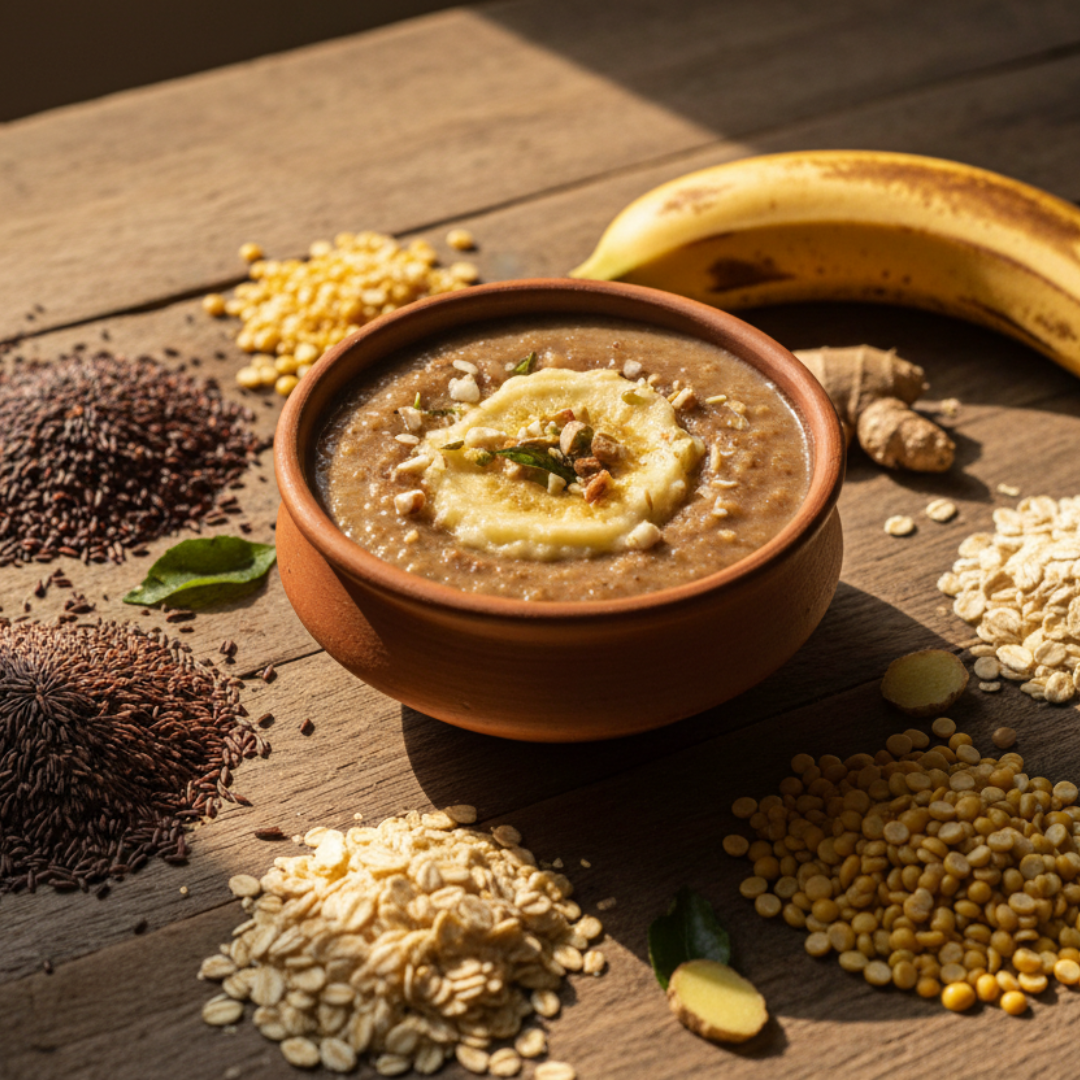
Your baby has started solids at 6 months — and now you are wondering: what comes next? How do you go from a few teaspoons of porridge to full family meals by the first birthday?
This complete Indian baby food chart covers every stage from 6 to 12 months — with a week-by-week meal plan, age-appropriate foods, portion sizes, Indian recipes and everything you need to feed your baby with confidence.
Save this page — you will come back to it often.
Baby Food Chart at a Glance (6–12 Months)
| Age | What to feed | Portion / meal | Solid meals / day | Texture |
|---|---|---|---|---|
| 6–7 months | Single-grain porridges (ragi, rice, oats), thin moong dal water, fruit & vegetable purées | 1–3 tsp → 2–3 tbsp | 1 / day | Smooth purées, thin porridge |
| 7–8 months | Combination porridges, moong dal khichdi, curd, more vegetables & fruit | 3–4 tbsp | 2 / day | Mashed with soft lumps |
| 8–9 months | Soft idli & dosa, paneer, egg, soft finger foods, mild spices | 4–6 tbsp | 2–3 / day | Mashed + soft finger foods |
| 9–10 months | Soft roti, dal tadka, soft sabzi, upma, makhana kheer | 6–8 tbsp (½ bowl) | 3 meals + 1–2 snacks | Soft lumpy + bite-size |
| 10–12 months | Soft family foods (dal, sabzi, roti, rice), eggs, paneer | ~½ adult portion | 3 meals + 2 snacks | Near family-food texture |
↔ Swipe sideways on mobile to see all columns.
Before You Begin — Important Reminders
- Breast milk or formula remains the primary source of nutrition until 12 months — solids are complementary, not a replacement
- Always introduce one new food at a time and wait 2 to 3 days before introducing another — this helps identify allergies
- Never add salt, sugar or honey to baby food before 12 months
- Always consult your pediatrician before starting solids or making significant dietary changes
- Every baby is different — use this chart as a flexible guide, not a strict rule
6 to 7 Months — Starting Solids
This is the beginning of your baby's solid food journey. The goal at this stage is exploration and getting used to swallowing — not nutrition. Breast milk or formula still provides all the nourishment your baby needs.
What to Feed at 6 to 7 Months
- Single grain porridges — ragi, rice, oats
- Simple vegetable purees — carrot, sweet potato, pumpkin
- Fruit purees — banana, apple (cooked), pear (cooked)
- Dal water — thin moong dal water is an excellent first food
- Raw Nendran banana porridge — a traditional South Indian first food rich in potassium
Portion Size at 6 to 7 Months
- Week 1 and 2: Start with 1 to 2 teaspoons per meal, once a day
- Week 3 and 4: Increase to 2 to 3 tablespoons, once or twice a day
- Texture: Smooth, lump-free purees or thin porridges
Sample Daily Meal Plan — 6 to 7 Months
- Morning (8 AM): Breast milk or formula
- Mid-morning (10 AM): 2 to 3 tbsp ragi porridge or banana porridge
- Afternoon (1 PM): Breast milk or formula
- Evening (5 PM): Breast milk or formula
- Night (8 PM): Breast milk or formula
Note: Offer solids after milk feeds at this stage — milk is still the priority.
7 to 8 Months — Building Variety
By 7 months your baby is getting more comfortable with solids. It is time to introduce more variety — more grains, more vegetables, lentils and fruit combinations.
What to Feed at 7 to 8 Months
- Combination porridges — oats with banana, ragi with dates powder
- Moong dal khichdi — rice and moong dal cooked very soft
- Vegetable purees — carrot, sweet potato, peas, spinach, beetroot
- Fruit — mashed mango, papaya, chikoo (sapota)
- Whole wheat porridge — introduced gradually
- Curd — plain, full-fat curd (not chilled)
Portion Size at 7 to 8 Months
- 3 to 4 tablespoons per meal
- 2 solid meals per day
- Texture: Mashed with soft lumps — begin moving away from completely smooth purees
Sample Daily Meal Plan — 7 to 8 Months
- Morning (7 AM): Breast milk or formula
- Breakfast (9 AM): 3 to 4 tbsp oats makhana porridge or banana ragi porridge
- Lunch (12 PM): 3 to 4 tbsp moong dal khichdi or sweet potato puree
- Afternoon (3 PM): Breast milk or formula
- Evening (6 PM): Breast milk or formula
- Night (9 PM): Breast milk or formula
8 to 9 Months — Increasing Texture and Variety
At 8 months your baby is likely sitting up well and showing strong interest in food. This is the time to introduce more texture, more finger foods and a wider range of flavours — including mild Indian spices.
What to Feed at 8 to 9 Months
- Soft idli and dosa — excellent Indian finger foods
- Soft cooked vegetables as finger foods — sweet potato, carrot, broccoli
- Paneer — soft cubes are rich in protein and calcium
- Whole wheat and almond porridge — great for brain development
- Soft rice with dal — cooked together until very soft
- Eggs — well-cooked scrambled egg or hard-boiled yolk
- Mild spices — a pinch of cumin, coriander or turmeric can be introduced
Portion Size at 8 to 9 Months
- 4 to 6 tablespoons per meal
- 2 to 3 solid meals per day
- Texture: Mashed with lumps, soft finger foods alongside spoon-fed meals
Sample Daily Meal Plan — 8 to 9 Months
- Morning (7 AM): Breast milk or formula
- Breakfast (9 AM): 4 tbsp whole wheat almond porridge + soft fruit pieces
- Lunch (12 PM): 4 to 5 tbsp rice khichdi with vegetables + soft idli strips
- Snack (3 PM): Mashed banana or small pieces of ripe mango
- Dinner (6 PM): 4 tbsp ragi porridge or moong dal with rice
- Night (9 PM): Breast milk or formula
9 to 10 Months — Exploring Family Foods
Your baby is becoming a more confident eater. By 9 months most babies can handle a wide variety of textures and are beginning to show strong food preferences. This is a great time to start sharing simple versions of family meals.
What to Feed at 9 to 10 Months
- Soft roti pieces — torn into strips or small pieces
- Dal tadka — without salt, with mild tempering
- Soft sabzi — lauki, tinda, turai cooked very soft
- Upma — cooked soft without salt
- Soft fruit pieces — banana, papaya, watermelon (deseeded)
- Small pieces of cooked chicken or fish — well cooked, bones removed
- Makhana porridge or kheer — calcium and protein rich
Portion Size at 9 to 10 Months
- Half a small bowl per meal (approximately 6 to 8 tablespoons)
- 3 solid meals per day plus 1 to 2 snacks
- Texture: Soft lumpy foods, small bite-sized finger foods
Sample Daily Meal Plan — 9 to 10 Months
- Morning (7 AM): Breast milk or formula
- Breakfast (8:30 AM): Oats porridge with mashed banana or soft idli with dal
- Mid-morning snack (11 AM): Soft fruit pieces or curd
- Lunch (1 PM): Rice with dal and vegetables
- Evening snack (4 PM): Makhana porridge or ragi pancake (homemade, no sugar)
- Dinner (7 PM): Soft khichdi
- Night (9 PM): Breast milk or formula
10 to 12 Months — Transitioning to Family Meals
In these final months before your baby's first birthday, the goal is to transition towards family meals — with appropriate modifications. Your baby is now eating 3 full meals a day and 2 snacks, alongside breast milk or formula.
What to Feed at 10 to 12 Months
- Soft versions of most family foods — dal, sabzi, roti, rice
- Eggs in various forms — scrambled, omelette, boiled
- Soft cooked chicken, fish or lentil patties
- Small pieces of cheese or paneer
- Varied fruits — most fruits are now fine, cut into small pieces
- Continue avoiding salt, sugar and honey until 12 months
Portion Size at 10 to 12 Months
- Small bowl per meal (approximately half an adult portion)
- 3 full meals plus 2 snacks per day
- Texture: Near-family food texture — soft but not mashed
Sample Daily Meal Plan — 10 to 12 Months
- Morning (7 AM): Breast milk or formula
- Breakfast (8:30 AM): Soft idli with chutney, or egg
- Mid-morning snack (11 AM): Fruit pieces, curd
- Lunch (1 PM): Rice with dal, soft vegetables
- Evening snack (4 PM): Banana porridge or soft fruit
- Dinner (7 PM): Khichdi with vegetables
- Night (9 PM): Breast milk or formula
Complete Week-by-Week Indian Baby Food Chart
Use this as a flexible weekly rotation. Always follow your baby's hunger and fullness cues — never force feed.
| Day | Week 1 — Introduction | Week 2 — Adding Grains | Weeks 3–4 — Building Variety |
|---|---|---|---|
| Monday | Rice kanji (thin rice porridge) | Ragi porridge | Oats makhana porridge + mashed banana |
| Tuesday | Rice kanji | Ragi porridge + mashed banana | Moong dal khichdi + carrot puree |
| Wednesday | Moong dal water | Oats porridge | Ragi porridge + sweet potato puree |
| Thursday | Moong dal water | Oats porridge + sweet potato puree | Whole wheat porridge + mashed papaya |
| Friday | Mashed banana | Rice + moong dal | Rice + moong dal + pumpkin puree |
| Saturday | Mashed banana | Rice + moong dal + carrot puree | Banana oats porridge + pear puree |
| Sunday | Milk only — rest day | Milk only — rest day | Soft idli + dal water |
↔ Swipe sideways on mobile to see all columns.
Best Indian Superfoods for Babies 6 to 12 Months
1. Ragi (Finger Millet)
The most calcium-rich grain available — more calcium than milk. Sprouted ragi is especially nutritious as sprouting increases iron absorption and makes it easier to digest. Excellent for bone strength and brain development.
2. Oats and Makhana
Oats provide sustained energy and fibre while makhana (fox nuts) are rich in calcium and protein. Together they make a powerful combination that supports brain development and keeps babies full for longer.
3. Moong Dal
The gentlest lentil for babies — moong dal is easy to digest, high in protein and rich in iron and zinc. It forms the base of khichdi, one of India's most perfect baby foods.
4. Nendran Banana
A traditional South Indian first food — Raw Nendran banana is richer in potassium and fibre than regular banana. It is naturally sweet, gentle on the tummy and provides sustained energy for active babies.
5. Sweet Potato
Naturally sweet, packed with Vitamin A and very soft when cooked — sweet potato is a perfect food throughout the 6 to 12 month journey, from smooth puree at 6 months to soft finger food by 8 months.
6. Ghee
Once solids are well established (usually around 7 to 8 months), a few drops of ghee added to porridge or khichdi significantly increases calorie density and adds healthy fats essential for brain development.
Foods to Avoid Before 12 Months
- Honey — risk of infant botulism
- Added salt — immature kidneys cannot process excess sodium
- Added sugar — zero nutrition, creates unhealthy preferences
- Cow's milk as a drink — fine in cooking but not as main drink before 12 months
- Whole nuts — serious choking hazard
- Round foods — whole grapes, cherry tomatoes — always cut lengthways
- Processed foods — hidden preservatives, salt and sugar
- Spicy food — too harsh for developing digestive systems
Practical Feeding Tips for Indian Parents
- Feed in a calm environment — no screens, no distractions
- Let your baby touch and explore food — messy eating is healthy development
- Offer new foods in the morning — easier to monitor for reactions
- Do not give up on rejected foods — it can take 15 to 20 tries before a baby accepts something new
- Eat together as a family — babies learn by watching
- Maintain consistent meal timings — helps baby's hunger rhythm
- Offer water in a small cup or sippy cup from 6 months — small sips alongside solids
Frequently Asked Questions
How many times a day should a 6 month old eat solids?
Start with once a day in the first week, then gradually move to twice a day by week 3 to 4. By 8 months you can offer three solid meals a day.
My baby refuses solids. What should I do?
Food refusal is very common in the early weeks. Keep offering without pressure. Babies may need to see and smell a food 10 to 15 times before accepting it. Never force feed — this can create negative associations with eating.
Can I add ghee to baby food?
Yes — a few drops of ghee from around 7 to 8 months adds healthy fats and calories. A little goes a long way — half a teaspoon mixed into porridge or khichdi is plenty.
When can I introduce spices?
Mild spices like cumin, coriander, turmeric and ajwain can be introduced from around 8 to 9 months in very small amounts. Avoid chilli and black pepper until after 12 months.
Should I be concerned if my baby's poop changes colour after starting solids?
Yes — this is completely normal! Introducing new foods changes poop colour, texture and smell significantly. Beetroot turns poop red, spinach turns it dark green. This is not a cause for concern unless there is blood or your baby seems unwell.
When to Seek Medical Advice
Consult your pediatrician if:
- Your baby consistently refuses all solids after several weeks of trying
- There are signs of an allergic reaction — rash, swelling, vomiting within 2 hours of eating
- Baby is not gaining weight appropriately
- There is persistent vomiting, diarrhoea or severe constipation
Short on time? Skip the cooking, not the nutrition.
Live Indianly's clean, preservative-free porridge & superfood mixes — ragi, whole wheat & almond, oats-makhana, moong dal and more — are ready in 5 minutes, with no added sugar, salt or preservatives.
Shop clean baby food →Final Thoughts
Feeding your baby from 6 to 12 months is one of the most joyful — and sometimes overwhelming — parts of the first year. The most important thing is to stay flexible, follow your baby's cues and trust that traditional Indian foods have everything your baby needs to grow well.
Ragi, khichdi, banana, dal, oats, makhana — these are not just foods. They are generations of Indian wisdom, packed into every bowl.
At Live Indianly, we make it easier for busy Indian parents with clean, preservative-free baby porridge mixes — crafted from the same traditional superfoods in this guide. Visit our free baby recipe library for more meal ideas across every stage.


